
The tests were conducted by the Indian Air Force, which will be the first service to induct the Akash missiles in its inventory.
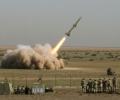
The People's Liberation Army Rocket (Missile) Force tested the new missile in the Bohai Sea.

DRDO scientists, who conducted the test, described it as a user's trial.

Describing the trial as "fully successful", the sources said, the sophisticated missile travelled for 19 minutes and covered 4,900 km.

The missile, developed by the DRDO, has a range of 3,500 km and it will be able to bring almost all parts of Pakistan and several areas of China within its reach, officials said.

The successful test will result in huge savings of replacement cost of missiles held in the inventory of the Indian Armed Forces.
The missile was aimed at a moving object, sources said.
Trishul is a short-range, quick-reaction, all-weather, surface-to-air missile designed to counter a low-level attack.

The interceptor, known as Advanced Air Defence missile, was engaged against an electronically prepared target which simulated the trajectory of a hostile ballistic missile.

It was for the first time that the missile, capable of travelling at speeds of up to Mach 3.0, or three times the speed of sound, was tested with indigenously developed 'seeker' technology.
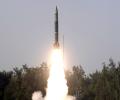
At present, the Pralay ballistic missiles can take out targets from 150 to 500 km and are extremely difficult to intercept for the enemy through interceptor missiles.
India on Friday successfully test-fired an indigenously developed supersonic interceptor missile, which is capable of destroying a hostile ballistic missile, from a test range off the Odisha coast. "At around 12.52 pm, the interceptor hit the target missile successfully at an altitude of about 15 kilometres," said Defence Research and Development Organisation spokesman Ravi Kumar Gupta.
It coincided with the test of the Prithvi missile conducted by India.
"The success of the mission assumes significance as DRDO scientists were able to 'continuously track the missile and feed its trajectory into computers to launch its interception."
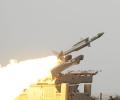
The missile targeted a floating object supported by the pilot-less target aircraft 'Lakshya', defence officials said.

Pakistan on Monday successfully test-fired a nuclear capable ballistic missile with a range of 900 kilometers, days after testing a similar missile capable of hitting targets as far as 1,500 kilometers, bringing many Indian cities under its range.

The missile is capable of intercepting incoming targets at an altitude of 15 to 25 km was launched against multiple simulated targets of 1,500 km class ballistic missile.
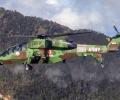
Of the 156 LCH, 90 would be for the Indian Army while 66 would be for the Indian Air Force.

Pakistan military spokesperson Lieutenant General Ahmad Sharif Chaudhry told a hurriedly called press conference in Islamabad at around 4 am that th Pakistan air force's Nur Khan (Chaklala, Rawalpindi), Murid (Chakwal) and Rafiqui (Shorkot in Jhang district) airbases were targeted.
Though the Ghauri can hit targets deep within India, Islamabad said it was not meant as a message for New Delhi.
The underwater leg of the nuclear triad has always been regarded as the most survivable. Going by the January 27 test, the K-15 missile is well up to the task. Ajai Shukla reports

'Pyongyang's strategy seems to be a cry to be treated as equal with the US and Beijing and this aspiration is premised on equipping itself with weapons as devastating as theirs,' says Rajaram Panda.

India on Friday successfully test-fired its indigenously developed sub-sonic long range cruise missile, 'Nirbhay' from the Integrated Test Range at Chandipur, Odisha.

'Everybody spies on their friends as well as their enemies. That's the way the world works these days'
India on Sunday successfully test fired its nuclear-capable ballistic missile 'Dhanush', with a range of 350 kilometers, from a naval ship off the Orissa coast.
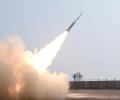
The Defence Research and Development Organisation on Friday successfully conducted a flight test of Solid Fuel Ducted Ramjet (SFDR) technology in Odisha, official sources said.

In the wake of the recent hostilities, both sides have moved from weapons to words, with India dispatching several delegations to visit more than 30 capitals across the world. A similar effort by Pakistan is set to start on Jun 2.

Top military officials from India and Pakistan highlighted their views at the Shangri-La Dialogue in Singapore, billed as Asia's premier defence forum, amid heightened tensions between the two sides following last month's military confrontation.

The sleek missile having 4000 km strike range is a two stage missile. It is 20 metre-long weighing 17 tonnes.
A mock air defence exercise relating to India's indigenously developed interceptor missile is carried out from Wheeler's island off the Orissa coast today.

Pakistan on Wednesday handed over Border Security Force (BSF) jawan Purnam Kumar Shaw, apprehended on April 23, to India via the Attari-Wagah border front in Punjab, the force said.
India successfully test-fired its indigenously developed nuclear capable sub-sonic cruise missile 'Nirbhay', which can strike targets more than 700 kms away, from a test range at Chandipur near Balasore in Odisha on Friday.

'Had Haji Pir and/or Skardu been taken, the message would have gone out not just to General Asim Munir and his cohort in the Pakistan army but to the Pakistani people that every terrorist incident in India would lead to substantial loss of territory in PoK.'
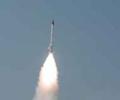
India on Sunday successfully test-fired a new interceptor missile capable of neutralising any incoming long-range missile at higher altitude.
Pakistan on Thursday test-fired its 1,300 km range nuclear-capable ballistic missile Hatf V, a day after it reached an agreement with India on nuclear risk reduction.

Agni-IV missile is equipped with 5th generation onboard computer and distributed architecture. It has the latest features to correct and guide itself for in-flight disturbance.

Agni-I missile is equipped with sophisticated navigation system which ensures it reaches the target with a high degree of accuracy and precision.
The indigenously developed low-flying stealth design missile, which can carry a nuclear or a conventional warhead, was tested at an undisclosed location.
Pakistan on Friday test fired nuclear-capable Hatf-7 cruise missile with a range of 700 km that can hit targets in India. The test of the "indigenously developed multi-tube" cruise missile system was successful, said a statement issued by the military. The Hatf-7 or Babur missile has stealth capabilities and can carry nuclear and conventional warheads, the military said. The test was witnessed by Chairman Joint Chief of Staff Committee Khalid Shameem Wyne.
